
See also


 18.11.2026 09:00 AM
Today, oil fell. Brent approached $92 per barrel after a modest rise on Tuesday, while WTI trades below $85. Traders are looking past new clashes in the Middle East and focusing on supply recovery and rising U.S. inventories.
Fighting has resumed, however. Kuwait and Bahrain reported intercepting attacks, and new strikes on vessels have been recorded in the Strait of Hormuz. On Tuesday, U.S. aircraft struck an Iranian missile-launch site on Qeshm Island after Tehran earlier hit Bahrain. The parties remain far apart on key issues, including Hormuz, though Iranian President Masoud Pezeshkian said Tehran is "seriously seeking" to resolve the impasse through diplomacy.
Supply, meanwhile, is growing. On November 13, the International Energy Agency for the first time since the start of the war noted that supply exceeds demand by about 2 million barrels per day, and one of the largest investment banks expects a noticeable surplus in the market in 2027. The American Petroleum Institute reported commercial crude inventories in the U.S. rose by 5.3 million barrels for the week versus an expected 0.5 million draw and a 9.0 million increase the week before. Gasoline and distillate stocks also increased. Official U.S. DOE data will be released tonight and are expected to show roughly a 0.4 million barrel build after a 4.66 million barrel rise the prior week.
Note the dynamics. On October 30 Brent was $116.06 — a six-month high — and now trades near $92, about 21% lower. Back then the market priced in the risk of a protracted war; now the picture is different: President Donald Trump did not resume full-scale strikes on Iran after the midterms, and Vice President J.D. Vance said Tuesday the U.S. does not intend to stay there long. Even Iran's strike on a U.S. base in Bahrain on November 15 — the first in the Gulf in several weeks — did not push Brent back over $100.
Clearly, the market has learned to separate individual flare-ups from a supply threat. The oil market has grown accustomed to such episodes unless they escalate into full-scale war. Downward pressure persists because the supply surplus and rising inventories give sellers fresh arguments.
Outside the Middle East, traders are watching the APEC summit in Shenzhen. On Thursday, Trump is expected to hold a trilateral meeting with China's Xi Jinping and Russia's Vladimir Putin, where Iran and Russia's invasion of Ukraine could be discussed. Risks remain: any new attack on ships in Hormuz or a strike on energy infrastructure could quickly put a geopolitical premium back into prices, and the China meeting could either ease tensions or introduce new uncertainties.
All this suggests oil remains pressured by a supply surplus. I expect Brent to trade around $88–$95 with a bias to the lower bound in the coming sessions, and a move above $100 is likely only under a full-scale escalation in Hormuz or a sharp cut to Gulf exports.
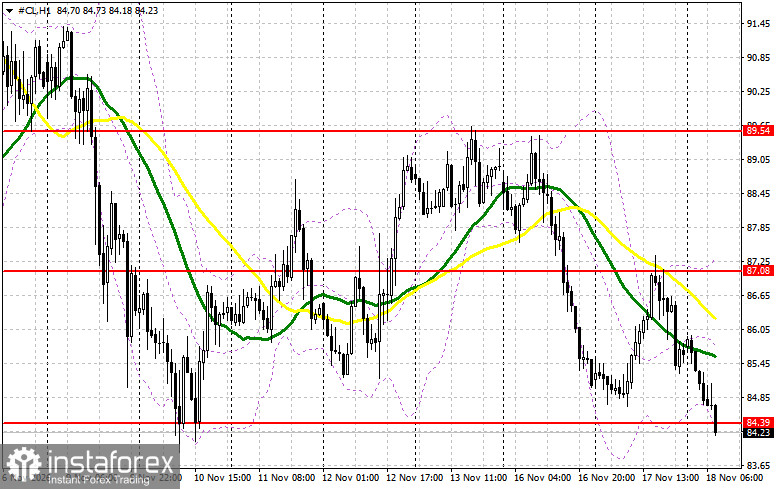
Technical picture: buyers need to take the nearest resistance at $87 to target $89, above which a breakout will be difficult. The farther target is around $92. On a drop, bears will try to seize control below $84. If they succeed, a range breakout would hit bulls hard and push oil toward a low of $81, with prospects of reaching $78.


